
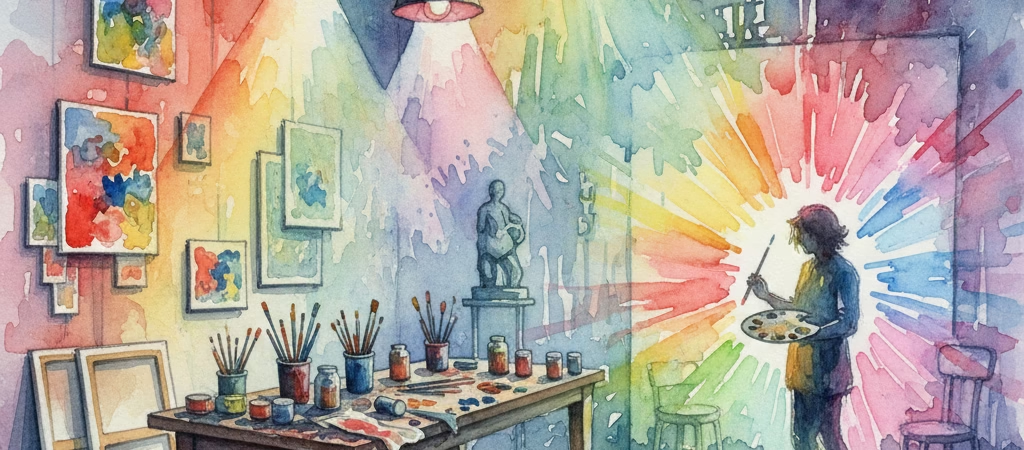
Or: How I Learned to Stop Squinting and Love Full Spectrum Lighting
Introduction: Let There Be (Good) Light
 Picture this: You’ve just spent three hours perfecting the subtle gradations in your watercolor sunset, only to discover the next morning that what you thought was a gorgeous coral pink is actually… well, let’s just say it’s the color of a traffic cone having an identity crisis. Welcome to the wonderful world of bad lighting, where colors go to die and artists go to develop chronic eye strain.
If you’ve ever wondered why your masterpiece looks completely different under your kitchen fluorescents than it did under your studio lights, you’re not alone. The culprit? Lighting that has about as much in common with natural sunlight as a vampire has with a beach vacation.
Enter full spectrum lighting—the superhero of the illumination world, here to save your retinas and your color perception from the tyranny of cheap fluorescent bulbs.
What Exactly IS Full Spectrum Lighting? (And Why Should You Care?)
Full spectrum lighting is essentially artificial light’s attempt to cosplay as the sun—and unlike most cosplay attempts, this one actually works. It replicates the complete spectrum of colors found in natural daylight, from the energizing blues of morning light to the warm ambers of sunset.
Think of regular fluorescent lighting as a cover band that only knows three songs, while full spectrum lighting is like having the original artist perform their entire catalog. The difference is night and day (pun absolutely intended).
The Science Behind the Magic
Here’s where things get nerdy (in the best possible way): Natural sunlight contains all wavelengths of visible light in balanced proportions. Your standard office fluorescent? It’s basically the lighting equivalent of a diet that consists entirely of energy drinks and stale donuts—technically it’ll keep you going, but you’re missing out on all the good stuff.
Full spectrum lights aim to replicate sunlight’s complete wavelength distribution, typically ranging from about 380 to 780 nanometers. This isn’t just marketing fluff—it’s the difference between seeing your art as it truly is versus seeing it through rose-colored glasses (or in this case, green-tinted fluorescent glasses).
The Great Company Roundup: Who’s Still Standing in 2026?
Let’s address the elephant in the room—or should I say, the companies that have left the room. After extensive research (and some digital detective work that would make Sherlock Holmes proud), here’s the current state of the full spectrum lighting landscape:
The Survivors and Thrivers
OttLite: The Phoenix Rises Good news for OttLite fans! While the company went through some corporate shuffling (acquired by Advantus Corp in 2023), they’re very much alive and kicking. In fact, they’ve evolved from those utilitarian lamps that looked like they belonged in a 1990s office to sleek, designer-friendly options that won’t make your studio look like a medical examination room.
Their current lineup includes everything from traditional desk lamps to modern floor lamps with USB charging ports—because apparently, even our lighting needs to be smartphone-compatible now.
The Daylight Company: Still Brightening Lives The Daylight Company continues to be the go-to choice for crafters, sewers, and artists who need precision lighting. Their website (daylightcompany.com) is alive and well, offering everything from magnifying lamps to LED panels that would make a photographer weep with joy.
Verilux: The Wellness Warriors Verilux has pivoted hard into the wellness lighting space, positioning themselves as “The Healthy Lighting Company.” They’re still based in Vermont (because apparently, good lighting and maple syrup go hand in hand), and they’ve expanded beyond just task lighting into light therapy and circadian rhythm support.
Companies I’m not sure of …
This does not mean these companies aren’t out there making great products. It just means I wasn’t able to find much online about them.
Vita-Lite: The Zombie Brand Vita-Lite exists in that strange internet limbo where you can still buy their products, but their main website looks like it was designed when dial-up internet was cutting-edge technology. The brand is still available through various retailers.
Full Spectrum Solutions: MIA This one’s a bit of a mystery. While you can still find references to Full Spectrum Solutions and their BlueMax products, their main website appears to have gone the way of the dodo. Some retailers still carry their products, but the company seems to have gone into stealth mode.
American Environmental Products/Sunalite: Plot Twist Here’s where things get interesting—the search results for “Sunalite” now primarily return information about polycarbonate sheets and laundry bleaching compounds. It appears the lighting company has either rebranded, been acquired, or decided to pursue other ventures entirely.
The New Kids on the Block: 2026’s Lighting Innovators
While some old-school companies have faded into the sunset, a new generation of lighting innovators has emerged, armed with LED technology and a better understanding of human biology than ever before.
Waveform Lighting: The Perfectionist’s Choice
Waveform Lighting has positioned itself as the brand for people who care about color rendering the way wine enthusiasts care about terroir. Their products boast 95+ CRI (Color Rendering Index) ratings, which is basically the lighting equivalent of having 20/20 vision.
Their CENTRIC series offers both home and daylight options, with the kind of technical specifications that would make an engineer swoon. We’re talking about lights that can render colors so accurately, you might actually see new details in your own artwork.
Ketra (by Lutron): The Luxury Option
If Waveform Lighting is for perfectionists, Ketra is for perfectionists with deep pockets. Acquired by Lutron, Ketra offers what they call “Natural Light” with their proprietary 4-channel light engine. Their A20 and S30 lamps can produce light ranging from 1,400K (think candlelight) to 10,000K (think arctic noon), with over 70 patents backing up their technology.
The catch? You’ll need a Lutron control system to make the most of it, and the price point is definitely in “investment piece” territory.
Lutron launched "Intelligent Lighting" at ISE 2026, embedding wireless control directly into each Ketra fixture, eliminating the need for low-voltage control wiring and centralized panels.
Philips Hue: The Smart Home Darling
Philips Hue has evolved far beyond simple color-changing party lights. Their latest offerings include circadian rhythm support and sleep optimization features. The Twilight Sleep and Wake-Up Light is designed to support your natural sleep cycle—because apparently, even our lighting needs to be wellness-focused now.
LIFX: The Tech-Forward Alternative
LIFX offers full spectrum capabilities with smart home integration that doesn’t require a separate hub. Their bulbs can produce over 550 billion color combinations (yes, billion with a ‘b’), and they’ve recently introduced antibacterial HEV light options for the germaphobe in all of us.
Govee and Nanoleaf: The Creative Disruptors
While not traditional full spectrum lighting companies, Govee and Nanoleaf have revolutionized how we think about lighting design. Govee’s RGBIC technology allows for multiple colors on a single strip, while Nanoleaf’s modular panels turn lighting into an art form itself.
The Science of Seeing: Why Your Eyes Will Thank You
Let’s talk about why full spectrum lighting isn’t just a fancy marketing term—it’s actually backed by science that would make your high school physics teacher proud.
The CRI Factor: Not Just Another Acronym
Color Rendering Index (CRI) measures how accurately a light source reveals colors compared to natural daylight, on a scale from 0 to 100. Most standard fluorescent lights score around 70-80 CRI, which is like watching a movie with the color saturation turned down. Full spectrum lights typically score 90+ CRI, revealing colors as they truly are.
To put this in perspective: under 70 CRI lighting, a red apple might look brownish. Under 95+ CRI lighting, that same apple looks like it just rolled off the tree in an orchard commercial.
The Eye Strain Equation
Recent studies have shown that full spectrum lighting can significantly reduce eye strain and fatigue. A 2022 study found that office workers under circadian lighting reported 19% better sleep quality and reduced eye strain compared to standard fluorescent lighting.
The reason? Your eyes are constantly working to adjust to the uneven spectral distribution of poor-quality lighting. It’s like trying to read a book while someone randomly adjusts the contrast—exhausting and ultimately counterproductive.
The Mood Connection
Here’s where things get really interesting: lighting doesn’t just affect how you see colors—it affects how you feel. Research has shown that exposure to full spectrum light can:
- Boost serotonin levels (your brain’s happiness chemical)
- Regulate circadian rhythms for better sleep
- Improve focus and cognitive performance
- Reduce symptoms of Seasonal Affective Disorder (SAD)
In other words, good lighting doesn’t just make your art look better—it makes you feel better while creating it.
The Psychology of Light: How Illumination Affects Creativity
A fascinating 2019 study published in Frontiers in Psychology examined how different lighting conditions affect art appreciation. While the researchers found that lighting changes had minimal impact on how people rated artworks, they discovered something more interesting: viewers naturally preferred light temperatures around 3777K—remarkably close to the warm white light of late afternoon sun.
This suggests that our brains are hardwired to prefer certain types of light, probably because we evolved under natural daylight conditions. When you’re working under lighting that matches these preferences, you’re not fighting against millions of years of evolution—you’re working with it.
The Color Temperature Sweet Spot
Different color temperatures affect our psychology in predictable ways:
- 2700K-3000K (Warm White): Relaxing, cozy, promotes creativity and free-flowing ideas
- 3500K-4100K (Neutral White): Balanced, comfortable for detailed work
- 5000K-6500K (Cool White/Daylight): Energizing, promotes focus and precision work
For art studios, many experts recommend adjustable lighting that can shift throughout the day, mimicking natural light patterns.
The Ultimate Lighting Setup: Building Your Perfect Studio
Based on extensive research and real-world testing, here’s how to create the ultimate art studio lighting setup:
The Foundation: Ambient Lighting
Start with torchiere-style floor lamps that bounce light off the ceiling. This creates even, shadow-free illumination that mimics overcast daylight—perfect for general studio work. Look for lamps that accept full spectrum bulbs in the 5000K-6500K range.
Pro Tip: Paint your ceiling white if it isn’t already. You’re essentially turning your entire ceiling into a giant softbox.
The Precision Layer: Task Lighting
For detailed work, you need adjustable task lighting with high CRI ratings. Consider:
- LED panels with 95+ CRI and adjustable color temperature
- Articulating arm lamps that can be positioned exactly where you need them
- Under-cabinet style strips for illuminating specific work areas
The Comfort Factor: Circadian Support
Add warm lighting (2700K-3000K) for evening work or when you want to create a more relaxed atmosphere. This prevents your studio lighting from interfering with your sleep cycle.
The Tech Integration: Smart Controls
Modern smart lighting systems allow you to:
- Program lighting scenes for different types of work
- Automatically adjust color temperature throughout the day
- Control everything from your phone or voice commands
The Great Lighting Myths: Busted
Let’s address some common misconceptions about studio lighting:
Myth 1: “More light is always better” Reality: Too much light can cause glare and eye strain. The goal is even, comfortable illumination, not a solar simulator.
Myth 2: “Expensive equals better” Reality: While quality costs money, you don’t need to spend thousands to get good lighting. A well-chosen $200 LED panel can outperform a $500 traditional lamp.
Myth 3: “Full spectrum lighting is just marketing hype” Reality: The difference in color rendering between quality full spectrum lights and standard fluorescents is measurable and significant.
Myth 4: “LED lights are harsh and cold” Reality: Modern LEDs can produce any color temperature you want, from warm candlelight to cool daylight.
Shopping Guide: What to Look For
When shopping for studio lighting, here are the key specifications to consider:
Essential Specs:
- CRI: 90+ minimum, 95+ preferred
- Color Temperature: Adjustable or multiple options (3000K-6500K range)
- Flicker-Free: Look for high-frequency drivers (>1000Hz)
- Dimming: Smooth dimming without color shift
Nice-to-Have Features:
- Smart controls: App-based control and scheduling
- Memory settings: Save your preferred lighting scenes
- USB charging: Because everything needs to charge something these days
Red Flags:
- No CRI rating listed: If they won’t tell you, it’s probably not good
- “Daylight” without specifications: Marketing term without meaning
- Extremely low prices: Quality lighting costs money—if it seems too cheap, it probably is. As an artist, I don’t have a lot of expendable income, so I bought lights one at a time when they were on sale. It took me a couple of years, but now I have a set up that works for me.
The Future of Studio Lighting
The lighting industry is evolving rapidly, with several exciting trends on the horizon:
Human-Centric Lighting (HCL)
This approach considers not just color accuracy but also the biological effects of light on human health and performance. Expect to see more lighting systems that automatically adjust throughout the day to support your natural rhythms.
AI-Powered Optimization
Some companies are developing lighting systems that use AI to learn your preferences and automatically adjust lighting based on the type of work you’re doing, the time of day, and even your personal circadian patterns.
Sustainable Solutions
As environmental concerns grow, expect to see more focus on energy-efficient lighting with longer lifespans and recyclable components.
Integration with Health Monitoring
Future lighting systems might integrate with wearable devices to monitor your stress levels, sleep patterns, and eye strain, adjusting automatically to optimize your well-being.
Wellness-focused lighting (major trend according to Lutron’s 2026 report)
Embedded controls in fixtures
Simplified installation systems
Conclusion: Seeing the Light
Good studio lighting isn’t just about seeing colors accurately—though that’s certainly important. It’s about creating an environment where you can work comfortably for hours without eye strain, where your creativity can flourish, and where the colors you see on your canvas will look the same when you hang the finished piece on a wall.
The lighting landscape has changed dramatically since the early days of utilitarian OttLite lamps and basic fluorescent tubes. Today’s options offer unprecedented control over color temperature, intensity, and even biological effects. Whether you’re a weekend watercolorist or a professional illustrator, there’s never been a better time to upgrade your studio lighting.
The investment in quality lighting pays dividends not just in better artwork, but in reduced eye strain, improved mood, and the simple pleasure of being able to see your work as it truly is. After all, you wouldn’t use cheap, low-quality paints or brushes—why compromise on the light that reveals their true colors?
So go forth, illuminate your creative space, and prepare to see your art in a whole new light. Your eyes—and your artwork—will thank you.
Remember: The best lighting setup is the one that works for your specific needs, space, and budget. Don’t be afraid to experiment, and don’t feel like you need to upgrade everything at once. Even small improvements in lighting quality can make a significant difference in your creative work.
Quick Reference: Recommended Products by Category
Budget-Friendly Options:
- Waveform Lighting CENTRIC HOME A19 bulbs: Great CRI at reasonable prices
- Basic LED panels with 90+ CRI: Available from various manufacturers
Mid-Range Choices:
- OttLite Designer Series: Stylish and functional
- Daylight Company task lamps: Proven performance for detailed work
- Verilux HappyLight series: Good for both task lighting and mood support
Premium Options:
- Ketra by Lutron: Ultimate color accuracy and control
- High-end Waveform Lighting fixtures: Professional-grade performance
- Philips Hue with circadian features: Smart home integration with health benefits
Smart/Tech-Forward:
- LIFX full spectrum bulbs: No hub required, extensive color range
- Govee RGBIC strips: Creative lighting effects with good color accuracy
- Nanoleaf panels: Artistic and functional lighting design
Prices and availability subject to change. Always check current specifications and reviews before purchasing.