 The Perfectionist’s Fallacy
As an experienced artist, I have learned that the greatest barrier to production is a misunderstanding of how art happens. A common misconception—often held by those outside the creative world—is that artists possess a fully rendered “mental photograph” that they simply project onto a canvas with surgical precision.
In reality, the distance between the initial spark and the finished product is a landscape of revisions, false starts, and “happy accidents.” This phenomenon is often called “The Gap,” a term popularized by public radio host Ira Glass. He notes that in the beginning, our taste is far ahead of our technical skill. We hit a block because we can see the “perfection” we want, but our hands cannot yet produce it.
The Sabotage of the Social Ego
The creative block is rarely about a lack of ideas; it is almost always a presence of fear. When an editor or client requests a specific commission, the stakes shift from personal expression to professional validation. The “inner critic” begins to scream:
- “What if I’ve run out of talent?”
- “What if my previous successes were just luck?”
- “What if they finally realize I’m a fraud?”
This is a form of Imposter Syndrome, a psychological pattern where individuals doubt their skills and have a persistent internalized fear of being exposed as a “fake.”
The Doctrine of the “Sanded Surface”
To move past this, an artist must enter into a covenant with the Creative Process. This requires a radical shift from focusing on the outcome to trusting the mechanism.
The Privilege of the Do-Over
One of the most liberating truths of art is its inherent resilience. Unlike a surgeon or a pilot, an artist has the divine privilege of the “Mulligan.”
- The Pentimento: In art history, a pentimento (from the Italian pentirsi, meaning “to repent”) is an alteration in a painting evidenced by traces of previous work. Many of the world’s masterpieces, including those by Rembrandt and Picasso, have entire abandoned paintings underneath their surfaces.
- The Iterative Method: You can sand a surface down, white-wash a canvas, or delete a chapter. These are not signs of failure; they are the “syntax of growth.” You don’t lose time when you start over; you gain a more sophisticated understanding of what not to do.
Success as a Process of Elimination
Trusting the process means believing that the answer is already inside you, waiting to be “uncovered.” Michelangelo famously claimed that he didn’t “carve” his statues; he simply removed the excess marble to reveal the figure already living inside the stone. Your “bad” drafts are simply the excess marble you must clear away to find your masterpiece.
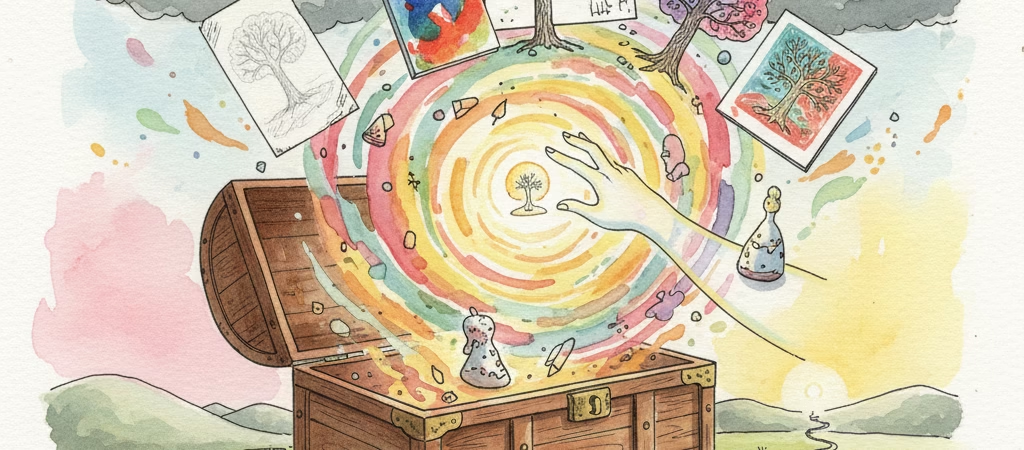
The Treasure Trove of Resilience
When the voice of insecurity becomes deafening, the most effective weapon is Objective Evidence. We often forget how powerful we are because we are too focused on the immediate fear.
Auditing Your History
To rebuild trust, look at your “treasure trove” of past victories. Think of the moments where you were certain you wouldn’t survive:
- The job interviews that made your hands shake.
- The “tough jobs” that felt like they would break you.
- The social situations where you felt like an outsider.
Every one of those moments is a data point proving your resilience. When you say, “I’ve gotten through a lot worse than this,” you aren’t just using positive thinking—you are stating a historical fact. You have a 100% success rate of making it through your hardest days.
Embracing the Ungainly
Creativity is frightening for two distinct reasons:
- The Absence of a Yardstick: There is no universal standard for “perfection” in a new creation. To create is to embrace the messy, the imperfect, and the experimental.
- The Vulnerability of Identity: It is difficult to separate what we make from who we are. When a piece is rejected, we feel our soul has been rejected.
The Slow Food of the Soul
We live in an “instant society” that expects results with the speed of a fast-food transaction. But art is “Slow Food.” As Julia Cameron emphasizes in The Artist’s Way, art needs time to incubate.
“Art needs time to sprawl a little, to be ungainly and misshapen and finally emerge as itself.”
If you stop moving, you stagnate. Stagnation is the only true failure in art. Even a “bad” drawing is a movement toward a “good” one. A blank canvas is the only thing that leads nowhere.
Conclusion: The Only Guarantee
There is only one absolute guarantee in the creative world: If you do not try, you will never succeed. Permission to fail is the key to the door of success. Allow yourself three “bad” drafts. Allow yourself a week of “lousy” sketches. In those “failed” efforts, you are building the muscle memory, the grit, and the technical insight that will eventually allow you to create the design that “gels.”
Trust the process. Trust your history. And most importantly, trust that smaller, quieter voice that whispered to you in the beginning: “I have something to share.”