A guide to overcoming artistic self-doubt and embracing your creative potential
The Silent Creativity Killer
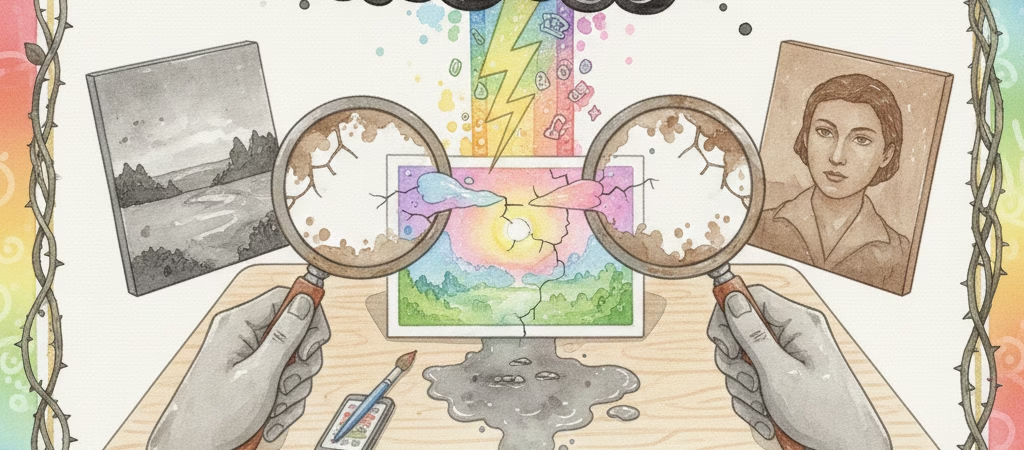
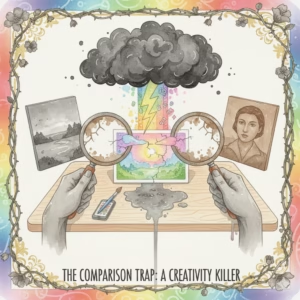 Picture this: You’ve just finished a painting you’re genuinely proud of. The colors sing, the composition feels balanced, and for a brief moment, you think, “I actually did something good here.” Then you scroll through Instagram, see another artist’s work, and suddenly your masterpiece feels like finger painting from kindergarten.
Sound familiar? Welcome to the comparison trap – one of the most effective ways to deflate your creative spirit faster than a punctured balloon at a birthday party.
Here’s the uncomfortable truth: When we compare our work to other artists, we’re not just being hard on ourselves – we’re engaging in a fundamentally flawed process that’s scientifically proven to undermine creativity and learning.
The Science Behind the Struggle
Recent research in creativity psychology reveals something fascinating about comparison and artistic development. A 2014 study published in Computers in Human Behavior found that social comparison significantly impacts creative performance, but not in the way you might expect. The research showed that upward comparison (comparing yourself to someone “better”) only improved creative quality for individuals who already had high creative confidence – everyone else actually performed worse.
Translation: If you’re already struggling with self-doubt, comparing yourself to more experienced artists isn’t motivating – it’s sabotaging.
Dr. Brooke Macnamara’s groundbreaking research at Purdue University further debunks the myth that talent is fixed or that some people are just “naturally gifted.” Her studies show that expertise is far more complex than the popular “10,000-hour rule” suggests, and that comparing your current abilities to someone else’s polished results ignores the invisible years of practice, failure, and growth that preceded their success.
The Assumptions That Sabotage Us
When we compare our work to another artist’s, we make several dangerous assumptions that always leave us on the losing end:
Assumption #1: “It Came Easily to Them”
We see the finished masterpiece but not the 47 failed attempts, the 3 AM frustration sessions, or the years of practice that made it possible. As Maya Angelou once admitted about her own imposter syndrome: “Each time I write a book, I think, ‘Uh oh, they’re going to find out now. I’ve run a game on everybody, and they’re going to find me out.’” Even literary giants struggle – they just don’t post their rough drafts on social media.
Assumption #2: “We Should Be at the Same Level”
This is perhaps the most arrogant assumption of all (though it rarely feels that way). Research from the National Art Education Association shows that artistic development follows predictable stages, each requiring specific time investments and experiences. Expecting to match someone who’s been painting for five years when you’ve been at it for five months is like expecting to run a marathon after jogging around the block twice.
Assumption #3: “There’s One ‘Right’ Way to Create”
If there were only one correct approach to art, we’d call it engineering, not creativity. The beauty of artistic expression lies in its infinite possibilities. Your unique perspective, experiences, and creative voice are not bugs in the system – they’re features.
The Real Cost of Comparison
The impact of chronic comparison extends far beyond momentary disappointment. Research published in the Journal of Creative Behavior shows that comparison-based thinking can:
- Reduce creative risk-taking by up to 40%
- Increase perfectionism to paralyzing levels
- Decrease intrinsic motivation – the joy that initially drew you to create
- Trigger imposter syndrome in 70% of creative professionals
Dr. Ceri Hand, who specializes in creative confidence, notes that comparison is particularly damaging because it shifts focus from internal growth to external validation. “When artists constantly measure themselves against others,” she explains, “they lose touch with their own creative voice and authentic expression.”
The Teaching Moment That Changed Everything
I once had a student – let’s call her Sarah – who became increasingly frustrated during our painting sessions. Week after week, she’d glance at my demonstrations, then at her canvas, and her shoulders would slump a little more. Finally, with more enthusiasm than tact (a occupational hazard of passionate teachers), I asked her:
“Isn’t it a little bit frustrating for you to think that after three lessons, you should paint as well as someone who’s been at this for thirty years? Why not give both of us a break and let yourself be a beginner for a while?”
The room went quiet. Then Sarah started laughing – really laughing. “You’re right,” she said. “I’ve been so busy trying to skip to the end that I forgot to enjoy the journey.”
From that moment, her work transformed. Not because she suddenly became “better,” but because she gave herself permission to be exactly where she was in her artistic development. Her paintings became more experimental, more joyful, and paradoxically, more skilled as she focused on learning rather than comparing.
The Neuroscience of Creative Growth
Recent neuroscience research reveals why comparison is so counterproductive to learning. When we’re in comparison mode, our brains activate the same stress responses associated with physical threat. This triggers the amygdala (our fear center) and suppresses activity in the prefrontal cortex – the very region responsible for creative thinking and problem-solving.
Conversely, when we approach our work with curiosity rather than judgment, we activate what researchers call the “default mode network” – a brain state associated with insight, innovation, and creative breakthrough.
The takeaway: Your brain literally works better when you’re not comparing yourself to others.
The Five Stages of Artistic Development (And Why They Matter)
Understanding where you are in your creative journey can help combat the comparison trap. Research identifies five distinct stages of artistic growth:
Stage 1: Foundation Building (Months 1-12)
Focus: Basic techniques, observation skills, tool familiarity What comparison does: Makes you feel hopeless about fundamentals What growth looks like: Gradual improvement in basic skills
Stage 2: Experimentation (Years 1-2)
Focus: Exploring different mediums and techniques What comparison does: Makes you feel scattered or unfocused What growth looks like: Discovering what resonates with you
Stage 3: Conceptual Development (Years 2-4)
Focus: Developing ideas and personal expression What comparison does: Makes you doubt your unique voice What growth looks like: Work becomes more intentional and personal
Stage 4: Style Refinement (Years 3-6)
Focus: Developing signature approaches and techniques What comparison does: Makes you copy others instead of developing authentically What growth looks like: Consistent personal aesthetic emerges
Stage 5: Professional Integration (Years 5+)
Focus: Portfolio development and career preparation What comparison does: Creates anxiety about market readiness What growth looks like: Confidence in presenting and selling work
The key insight: Each stage has its own timeline and challenges. Comparing your Stage 2 experimentation to someone’s Stage 4 refinement is like comparing apples to rocket ships.
The Social Media Amplification Effect
Today’s artists face a unique challenge: the constant stream of curated perfection on social media. A 2025 study on musicians and social media found that platforms like Instagram can create what researchers call “content factory pressure” – the feeling that you must constantly produce and share work to remain relevant.
The hidden truth about social media: You’re seeing everyone else’s highlight reel while living your own behind-the-scenes reality. That stunning artwork that makes you question your abilities? It might be the artist’s one success after twenty attempts, carefully photographed in perfect lighting, with the failures conveniently cropped out.
Reframing Comparison: From Poison to Medicine
Here’s the plot twist: not all comparison is toxic. Research shows that when used strategically, observing other artists’ work can actually accelerate learning. The key is shifting from evaluative comparison (judging your worth) to informational comparison (gathering insights).
Toxic Comparison Sounds Like:
- “I’ll never be as good as them”
- “They’re so much more talented”
- “I should just quit”
- “Everyone else makes it look so easy”
Healthy Comparison Sounds Like:
- “I wonder what technique they used for that effect”
- “That color combination is interesting – I’d like to experiment with something similar”
- “Their composition choices give me ideas for my next piece”
- “I can see how much they’ve grown over the past year”
The Growth Mindset Revolution
Stanford psychologist Carol Dweck’s research on growth mindset has profound implications for artists. Her studies show that people who believe abilities can be developed (growth mindset) significantly outperform those who believe talent is fixed (fixed mindset).
In art education specifically, research shows that students who adopt growth mindset approaches:
- Show 23% greater improvement in technical skills
- Demonstrate increased willingness to experiment
- Report higher satisfaction with their creative process
- Are more likely to persist through challenges
The practical application: Instead of “I’m not good at drawing hands,” try “I’m not good at drawing hands yet.” That simple word – “yet” – acknowledges your current reality while keeping the door open for growth.
Practical Strategies for Breaking Free
1. The Success Journal Method
Research on creative confidence shows that documenting progress significantly improves self-perception and motivation. Keep a record of:
- Techniques you’ve learned
- Problems you’ve solved
- Moments of creative satisfaction
- Positive feedback received
Why it works: Our brains are wired to notice problems and forget successes. A success journal counteracts this negativity bias.
2. The Learning Focus Shift
Instead of asking “Is this good?” ask:
- “What did I learn from this piece?”
- “What would I do differently next time?”
- “What technique do I want to explore next?”
3. The Inspiration vs. Intimidation Filter
When viewing other artists’ work, notice your emotional response:
- Inspiration: “This makes me want to create”
- Intimidation: “This makes me want to quit”
Seek out more inspiration sources and limit exposure to intimidation triggers, especially during vulnerable creative periods.
4. The Time Perspective Technique
When you catch yourself comparing, ask:
- “How long has this artist been practicing?”
- “What was their work like when they were at my stage?”
- “What might my work look like with continued practice?”
The Uniqueness Advantage
Here’s something the comparison trap makes us forget: your differences are your strengths. The art world doesn’t need another perfect copy of someone else’s style – it needs your unique perspective, experiences, and creative voice.
Consider these famous artists who were initially criticized for being “different”:
- Van Gogh sold only one painting in his lifetime
- Monet was rejected by the Paris Salon multiple times
- Picasso was told his early work was “too strange”
Their “flaws” became their signatures. Your creative quirks aren’t bugs to be fixed – they’re features to be developed.
The Practice Paradox
Research consistently shows that the most effective way to improve at art is through deliberate practice – focused, challenging work that pushes your current abilities. But here’s the paradox: comparison often prevents us from engaging in the very practice that would help us grow.
When we’re focused on how far behind we are, we avoid challenges that might reveal our limitations. When we embrace our current level and commit to growth, we seek out exactly the challenges we need.
The bottom line: The fastest way to close the gap between where you are and where you want to be is to stop measuring the gap and start walking the path.
Your Creative Journey is Not a Race
Art is not a competition with a finish line. It’s a lifelong journey of discovery, expression, and growth. Every artist – from the weekend hobbyist to the museum-featured master – is somewhere on this journey, learning, growing, and occasionally struggling with doubt.
The most successful artists aren’t those who never compare themselves to others – they’re those who’ve learned to use comparison as information rather than evaluation, as inspiration rather than intimidation.
The Permission You’ve Been Waiting For
If you’re reading this and recognizing yourself in these words, consider this your official permission slip:
- Permission to be a beginner – even if you’ve been creating for years
- Permission to make “bad” art while you’re learning
- Permission to have your own timeline for growth and development
- Permission to find joy in the process rather than just the outcome
- Permission to be uniquely, authentically you in your creative expression
The Path Forward
The next time you feel that familiar sting of comparison, remember this: every artist whose work you admire was once exactly where you are now. They had the same doubts, the same frustrations, and the same moments of wondering if they’d ever “get it.”
The difference isn’t talent – it’s persistence. It’s the willingness to keep creating, keep learning, and keep growing despite the inner critic that whispers you’re not good enough.
Your creative journey is uniquely yours. Your timeline is your own. Your voice matters. And your next piece – whatever it looks like – is exactly what you need to create right now.
So pick up that brush, pencil, or stylus. Stop comparing. Start creating.
The world is waiting to see what only you can make.
Remember: Art is not about perfection – it’s about expression. It’s not about being the best – it’s about being authentically you. And it’s definitely not about comparing your chapter 3 to someone else’s chapter 20.
Your creative journey starts now. Again. And that’s perfectly, beautifully okay.