
 The Anatomy of Artistic Avoidance
Learning any craft requires practice—and lots of it. Unfortunately, we all hit blocks where the distance between our current skill and our creative vision feels insurmountable. When we cannot bridge that gap, we often fall into sophisticated procrastination habits that make us feel like we are working without actually producing anything.
Common Procrastination Archetypes
- The Curator (Supply Hoarding): This is the most common device—buying books, high-end paints, or specialized tools but never breaking the seal on them. This creates a “shadow career” where you feel connected to the art world through consumption rather than creation.
- The Visionary (Future-Tripping): You spend hours daydreaming about your life as a full-time artist or successful author. By focusing on a distant, idealized success, you make the actual work feel mundane or intimidatingly high-stakes.
- The UFO Collector (Unfinished Objects): You have a graveyard of half-painted canvases or partially written chapters. This is often driven by a fear of “the finish,” where a project must face final judgment. Eventually, the sheer volume of “UFOs” creates a mental weight that leads to total paralysis.
Understanding Overwhelm: The “Red Traffic Light”
Overwhelm is the great “red traffic light” for creativity. It is rarely caused by having too much to do; it is caused by trying to hold it all at once.
In psychology, this is related to Executive Function and Cognitive Load. When we look at a finished masterpiece, we see the “Big Picture.” When we try to start our own, we try to process the entire “Big Picture” simultaneously, which leads to Decision Paralysis.
Pro Tip: In his book The War of Art, Steven Pressfield calls this “Resistance.” Resistance is an active force that tries to keep us from our work by magnifying the difficulty of the task until we give up.
The Path: Stepping Stones vs. Mountains
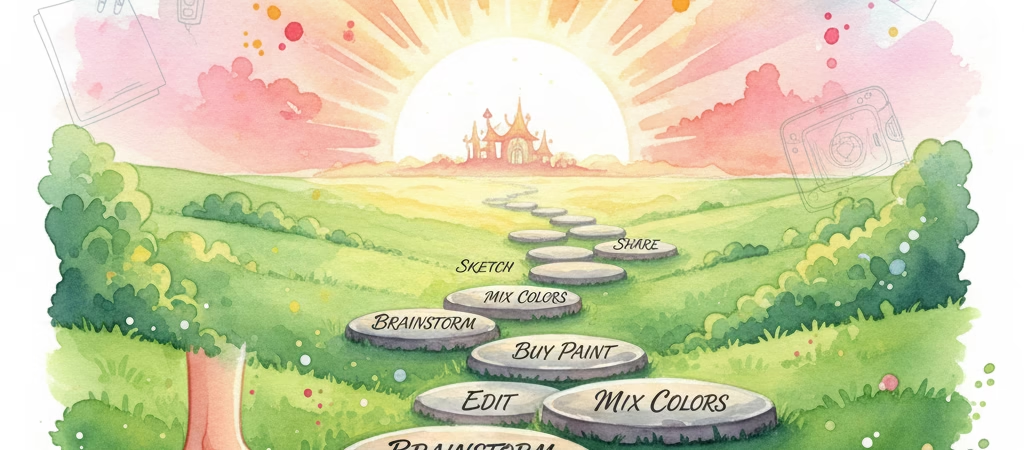
All creative projects are a journey from where you are now to where you want to be. The secret to sustainable progress is treating your project not as a mountain to climb, but as a path of individual stones.
The Power of “Micro-Tasks”
Our path is made of stones that are individual tasks. While it may seem that all of them have to be done at once, they don’t. This aligns with the Kaizen Method, a Japanese philosophy of continuous improvement through small, incremental changes.
How to Identify Your Stones
Defining these “stepping stones” is ongoing work. If you try to define every step at the beginning, you will likely go in the wrong direction because the process of creating actually teaches you what the next step should be.
- Don’t set a goal to “Be an Artist.” That is too heavy.
- Set a goal to “Buy one tube of Crimson paint.” That is a stone you can step on today.
- The Next Stone: Instead of “Learn to Paint,” your stone might be “Google ‘Watercolor teachers in Shawnee, OK’” or “Sketch for 10 minutes while the coffee brews.”
The Second Key: Radical Self-Compassion
The most critical part of the journey is managing your reaction to the “slow days.” We often live for the satisfaction of crossing items off a “to-do” list, but creativity is non-linear.
Giving Yourself Permission to “Be”
If the perceived lack of “progress” frustrates you, you will trigger the amygdala—the part of the brain responsible for fear—which will send you right back into the procrastination cycle.
- The 5-Minute Rule: If you are overwhelmed, promise yourself you will work for just five minutes. Often, the hardest part is the friction of starting. Once you are on the stone, the next one becomes visible.
- Incubation Time: Sometimes, not doing the work is part of the work. Your brain needs time to process ideas (incubation). The trick is to distinguish between “necessary rest” and “avoidance.”
Summary Checklist for Getting Unstuck
| The Problem | The Small Step (Stone) |
| Too many supplies | Pick one medium and one tool for today. |
| Fear of the Big Picture | Ask: “What is the smallest thing I can do in 5 mins?” |
| UFO Overload | Choose one unfinished project and do the final 10%. |
| Daydreaming vs. Doing | Set a timer for 15 minutes of “messy” practice. |
Final Thought
Take one small step, as often as possible. You don’t have to see the end of the road to know you’re on the right path. As long as you are moving, you are the artist you want to be.
Resources
- “Atomic Habits” by James Clear: Excellent for understanding how small, 1% improvements lead to massive shifts in creative output.
- “Bird by Bird” by Anne Lamott: A classic text on creative writing that emphasizes taking tasks “one small step at a time.”
- The Pomodoro Technique: A time-management method that breaks work into 25-minute intervals, perfect for overcoming the friction of starting.