
 How a college creativity exercise evolved into a lifelong practice that’s now embracing the digital age
When I was 18 years old, and in my first summer semester at college, I had the great fortune of taking a class called “Theatre Creativity.” In it, we were challenged to do a number of creative exercises that changed my life forever. From allowing a fellow student to guide us, blindfolded, around campus, to sharing our most embarrassing moment before the entire class, the teacher pushed us to understand that our lives were important; in fact, our lives were our art, and we had the ability to create things we never imagined, if we would only try.
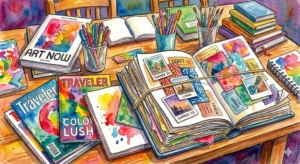
The creativity exercise that had the most long-lasting effect on my life was the creation of a multi-media journal. Because this was a summer class, we had only 6 weeks to work. During the six weeks, we were challenged to create art, decorate, or write in every page of a blank book. Some of the students chose the smallest blank books they could find, but I marched into an art store (foreign territory for me at the time) and purchased an 8 ½” x 11″ artist sketchbook. Over the next six weeks I filled it with the story of my life at that time – with art, Polaroid photos, sketching (which was pretty bad as I’d had no formal art training), the ephemera of my life, as well as writing.
The book made me see myself in a completely new light. I could write, draw, and document my life on paper! I created the journals faithfully from the time I was 18 until I was 40. The books are now known as “art journals” or “scrapbook journals.” Over the years, the scrapbook journals evolved. What started out as white paper filled with teenage ramblings, clippings from magazines, and other ephemera from my life (movie tickets, postcards, etc.), became a color-filled panorama of my life. I painted the pages (about 20 at a time until they are filled, and then I painted 20 more – often using leftover paint from other painting projects.)
The Evolution of Instant Documentation
The most important change to my scrapbook journals over the years has been photography and how we capture moments. Originally I began by using a Polaroid camera, as immediacy is important when journaling. Unlike a traditional scrapbook, where you might gather photos and ephemera for a while and put it together with traditional components, scrapbook journals are scrapbooks on the fly! There is great power in being able to record an event as it happens, or that night when the kids are in bed and it is all fresh in your mind.
From Film to Phone: The 2026 Revolution
My scrapbooks changed forever when digital cameras entered my life, but the real revolution came with smartphones. Today, in 2026, I carry more photographic power in my pocket than entire photography studios had when I started journaling. But it’s not just about taking photos anymore—it’s about instant creation and endless possibilities.
The latest breakthrough in instant cameras is Fujifilm’s instax mini Evo Cinema, released in early 2026, which combines digital photography with instant printing AND video capture. You can now create mini-movies of moments and print them as QR codes that link to the full video when scanned. It’s like having a time machine in my journal pages!
But the real game-changer has been smartphone printing technology. The new instax mini Link+ printer connects wirelessly to your phone and can print photos with augmented reality features embedded right into the print. When you hold my phone over certain photos in my journal, additional content appears—videos, voice notes, even 3D animations I’ve created.
The AI Creative Assistant Revolution
Perhaps the most dramatic change in my journaling practice has been the integration of AI tools. In 2026, I’m not just documenting my life—I’m collaborating with artificial intelligence to enhance my creativity in ways I never imagined.
Digital Scrapbooking Meets AI
Platforms like ReelMind.ai have transformed how many approach digital elements. You can now:
- Multi-image fusion: Blend multiple photos from an event into cohesive panoramic scenes
- Consistent character generation: Create illustrated versions of family members that appear throughout my journals
- Style transfer: Transform ordinary photos to match the aesthetic of each journal’s theme
- AI-generated backgrounds: Create custom papers that perfectly match my color schemes and moods
The “zine culture” aesthetic that’s trending in 2026 is perfect for journaling. AI tools can now generate realistic torn paper edges, vintage textures, and authentic-looking tape and adhesive effects that would have taken hours to create manually.
The Junk Journaling Renaissance
One of the most exciting trends is “junk journaling”—repurposing everyday items and “trash” into beautiful journal elements. My older sister loves these and has created some stunning journals. My favorite being a set she gave me for my birthday a couple years ago that contained all my parents love letters to one another.
But in 2026, even this has gotten a digital twist. You can scan receipts, packaging, ticket stubs, and other ephemera, then use AI to enhance them, change their colors, or create artistic interpretations while maintaining their authentic feel.
Your smartphone’s advanced scanning capabilities can now capture textures and create 3D models of objects. That beautiful letter opener I got at the LA County Museum of Art? I can now create a 3D scan and print it at different scales, in different materials, or even animate it for digital journal pages.
Making It Interesting: 2026 Edition
The creative possibilities available today would have seemed like science fiction when I started journaling. Here are some of the techniques I’m using now:
Smart Papers and Adaptive Printing
- Thermochromic papers: Pages that change color with temperature, revealing hidden messages or images
- Conductive ink printing: Create interactive elements that respond to touch
- Augmented reality markers: Print special symbols that trigger digital content when viewed through my phone
- Biodegradable smart papers: Eco-friendly options that can display digital content while maintaining sustainability
AI-Enhanced Custom Creation
- Personalized pattern generation: AI analyzes my color preferences and creates unique patterns for backgrounds
- Voice-to-visual: Speak a memory or feeling, and AI generates abstract art to represent it
- Mood-responsive layouts: AI suggests page layouts based on the emotional content of my writing
- Collaborative storytelling: AI helps me explore “what if” scenarios in my life stories
Mixed Media in the Digital Age
The line between physical and digital has completely blurred. I now create:
- Hybrid pages: Physical backgrounds with digital overlays viewable through AR
- Interactive timelines: QR codes that link to video montages of specific time periods
- Sensory integration: Embedded scent capsules that release fragrances when pages are opened
- Community connections: Shared digital elements that connect my journals with other artists worldwide
The Instant Everything Era
Sometimes when we did traditional scrapbooking, the search for the perfect sticker or background paper became all-consuming. However, these pieces reflected someone else’s art. In 2026, the tools available—from AI image generation to instant printing to augmented reality—mean I can create exactly what I envision, when I envision it.
My current setup includes:
- Smartphone with AI camera: Automatically suggests compositions and can generate missing elements
- Portable instant printers: Multiple options for different paper types and effects
- Digital stylus and tablet: For creating digital art that seamlessly integrates with physical pages
- Voice recording jewelry: Wearable devices that capture audio throughout the day for later integration
- Smart lighting: Adjusts automatically for optimal photography and color accuracy
The Community Aspect: Journaling Goes Social
One of the most beautiful developments in 2026 has been how journaling has become a community activity while remaining deeply personal. Through hashtags like #artjournal2026, #junkjournaling, and #mixedmedialife, You can connect with thousands of other journalers worldwide.
The Mixed Media Morsels community has grown into a global movement, with monthly challenges and collaborative projects. You can now participate in “journal swaps” where artists from different continents contribute pages to each other’s books, creating truly international artistic collaborations.
AI translation tools mean language is no longer a barrier—You can collaborate with artists who speak different languages, with real-time translation of both text and artistic concepts.
Sustainability Meets Creativity
As environmental consciousness has grown, so has the focus on sustainable journaling practices. In 2026, I’m using:
- Recycled and upcycled materials: Enhanced with AI to create beautiful new textures and patterns
- Digital-first approaches: Reducing physical waste while maintaining tactile experiences through haptic feedback
- Biodegradable smart materials: Papers and inks that break down safely while maintaining their interactive properties
- Carbon-neutral printing: Local print-on-demand services powered by renewable energy
It’s All Yours: The Personal Touch in an AI World
Whenever you stop to create a page in your scrapbook, remember that it is an expression of you! Everything in your toolkit—from AI-generated elements to traditional materials, from smartphone cameras to vintage ephemera—are ways for you to express your unique perspective on life.
The key in 2026 is finding the right balance between technological enhancement and personal authenticity. AI can suggest, enhance, and create, but the stories, memories, and emotions are uniquely yours. Your journals tell the story of your life in a way that no algorithm can replicate.
Looking Forward: The Future of Creative Documentation
As I work on my 55th journal, I’m amazed by how far we’ve come from those early Polaroid days. But I’m even more excited about what’s coming next. Emerging technologies like:
- Neural interface creativity: Direct brain-to-art translation
- Holographic journaling: Three-dimensional memory preservation
- Time-capsule integration: Journals that automatically update with new information about past events
- Emotional AI: Technology that can capture and recreate the emotional atmosphere of moments
The tools continue to evolve, but the core purpose remains the same: documenting our lives, expressing our creativity, and preserving our stories for future generations.
A Great Way to Start
If you’re inspired to begin your own creative journaling journey in 2026, remember that you don’t need every new gadget or app to get started. Begin with what you have—even if it’s just a smartphone and a notebook. The most important element is your willingness to document your life and express your creativity.
Your art journals tell the story of your life. Make sure they do it in a way that shows just how unique and special your life is in every detail! Whether you’re using AI-generated backgrounds or hand-drawn doodles, vintage Polaroids or holographic prints, the goal is the same: creating a visual autobiography that captures not just what happened, but how it felt to be you, living your life, in this moment in time.
The technology will continue to change, but the human need to create, document, and share our stories remains constant. In 2026, we just have more beautiful, exciting, and accessible ways to do it than ever before.
The author continues to create art journals from her studio, now equipped with both traditional art supplies and cutting-edge creative technology. Her many completed journals span four decades of personal and technological evolution, serving as both artistic expression and historical documentation of how creativity adapts to new tools while maintaining its essential human core.